T Rex Trackway
Researchers identify the first known trackway left by an adult Tyrannosaurus rex in North Dakota rock.
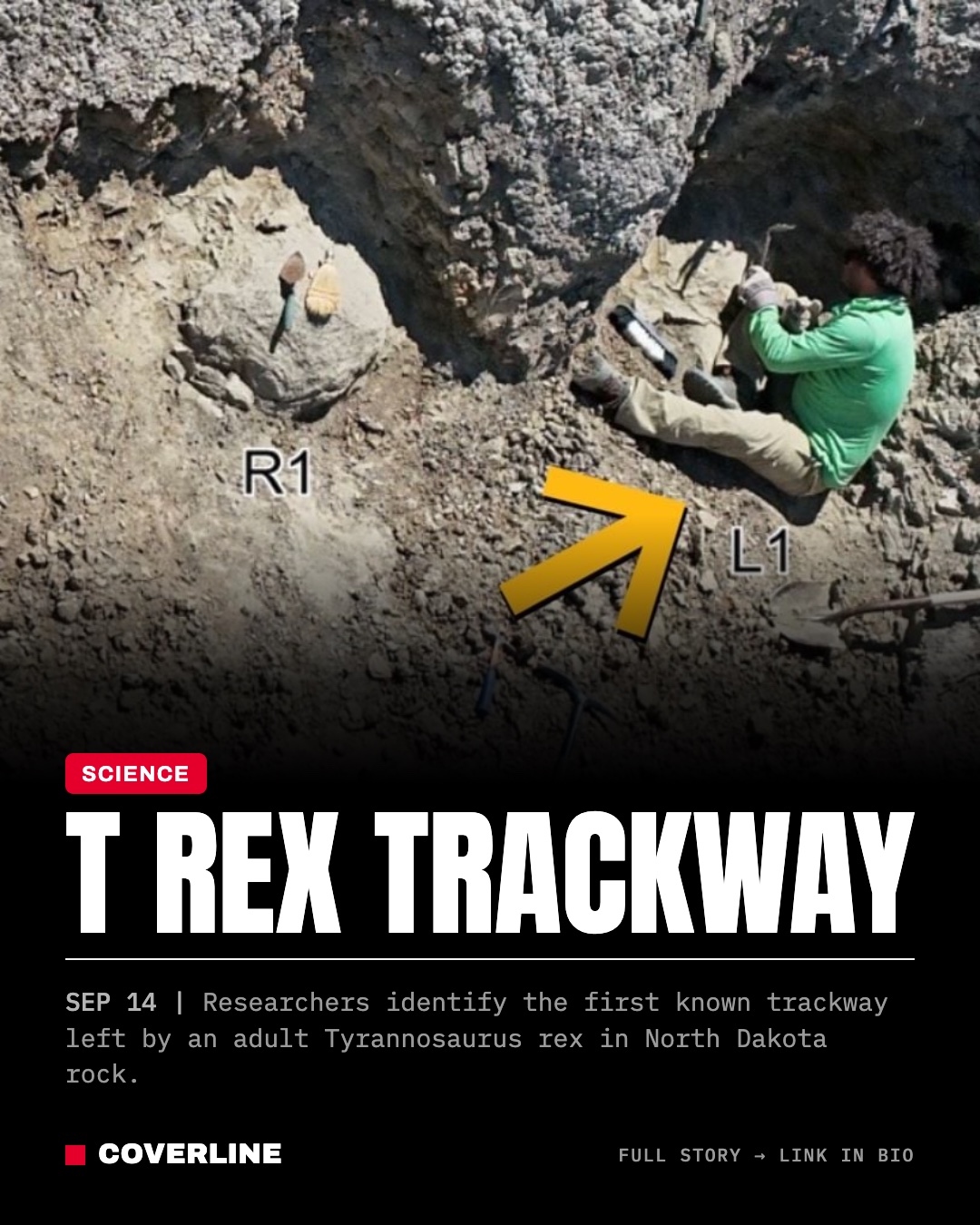
66.5 million years ago, a Tyrannosaurus rex walked across what is now North Dakota and left its mark. Paleontologists have just found the first known trackway made by an adult of the species.
The trackway runs roughly 23 feet and holds four footprints, each about a meter long, cemented in place by calcium carbonate, ScienceAlert reported. Track spacing points to a stride of nearly 13 feet. That works out to a walking speed of 3.3 to 4.5 miles per hour, brisk for an animal that size but still less than double a typical human pace.
Skeletons of T. rex are common. Tracks are not. Only two isolated footprints had ever turned up before this one, in New Mexico and Montana, according to the study's authors as reported by ScienceAlert, and neither belonged to a full trackway like this one.
The tracks sit near the top of the rock layer that ends at the Cretaceous boundary, laid down not long before the asteroid strike that wiped out the non-avian dinosaurs. Finding tracks and bones from the same era in the same place is rare, since trackways get trampled by other animals and shifting sediment can blur a print's true shape. Three-toed tracks left by meat-eating theropods can also look like those left by plant-eating ornithopods, which complicates identification.
Given the age of the rock, the location and the shape of the prints, the study's authors concluded an adult T. rex is the most likely trackmaker, ScienceAlert reported. Their find appears in the Journal of Vertebrate Paleontology.
A 2014 study in PLOS One documented tracks from three smaller tyrannosaurids moving together, evidence some members of the family may have traveled in groups. Researchers say more excavation in the area could turn up further prints, ScienceAlert reported.
Tyler Lyson, a senior curator of vertebrate paleontology at the Denver Museum of Nature & Science and a co-author of the study, put it plainly. "Bones tell us an enormous amount about these animals, but footprints capture a moment of behavior," he told ScienceAlert. A trackway, he added, lets researchers trace an animal's movement across ground it once crossed, something rare for T. rex.