Dark Matter Signal
A dark matter detector deep in a South Dakota mine catches a signal scientists can't fully explain.
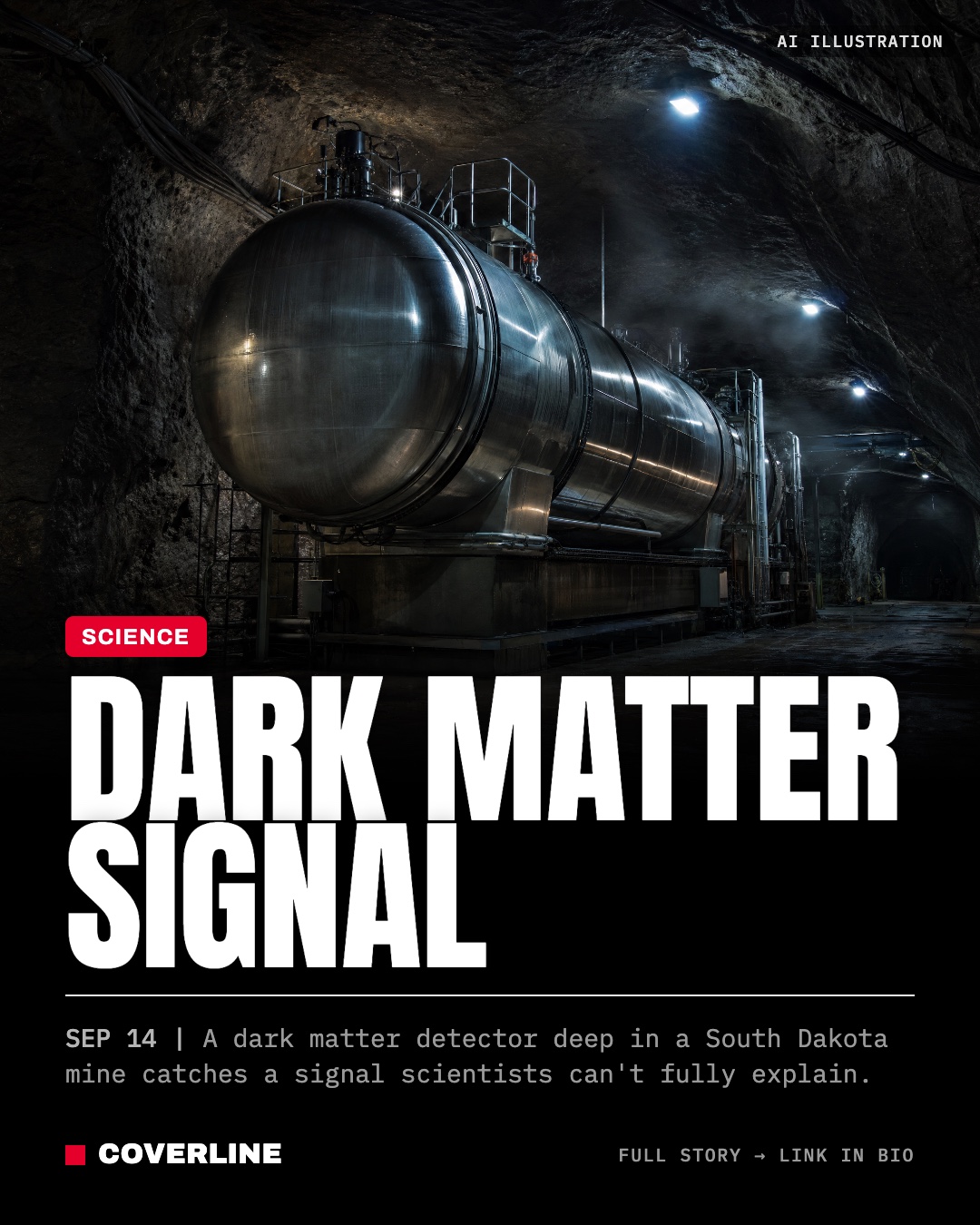
A mile under South Dakota, a detector caught a signal scientists can't explain. It's the strongest dark matter hint yet.
The LUX-ZEPLIN experiment, known as LZ, sits inside a former gold mine at the Sanford Underground Research Facility. CNN put the detector's xenon at 7 active metric tons. Gizmodo and the Economic Times put the tank closer to 10 tons total. On June 16, 2023, at 3:22 p.m. and 39 seconds, the tank flashed with light, cameras and hair-thin wires catching an electric charge, Scientific American reported.
Dark matter makes up about 85% of the matter in the universe, CNN and Gizmodo both reported. No telescope has ever seen it. It doesn't absorb or reflect light. Scientists infer it from gravity, from galaxies that spin too fast and clusters that hold together too tightly for the visible matter inside them, according to Gizmodo.
LZ hunts for a theoretical particle called a WIMP, short for weakly interacting massive particle. If the 2023 signal came from one, Gizmodo reported, that particle would weigh about 200 times more than a proton, and it struck with unusual force.
Researchers estimate just a 0.5% chance a known background caused the flash, CNN and Scientific American reported. Still short of proof. Physics calls a discovery only at 5-sigma confidence, a 1 in 3.5 million shot of a fluke. This result sits at 2.6-sigma, about 1 in 200, according to CNN.
"We are not claiming to have seen dark matter," Rick Gaitskell, the LZ spokesperson and a Brown University physicist, said in a statement carried by Gizmodo. "But we have seen something interesting that we want to share with the scientific community for their input." Lead author Sam Eriksen of the University of Bristol offered the same caution to the Economic Times. "We are not claiming that it is dark matter," he said.
The LZ team presented the finding September 1 at the TeV Particle Astrophysics conference in Japan and submitted a paper to Physical Review Letters, CNN reported. Scientists are now combing through fresh data, hoping more events push the statistical significance higher.
Katherine Freese, a theoretical physicist at the University of Texas at Austin, has waited decades for a moment like this one. "I have been waiting for a positive result for, oh, my god, 40 years," she told Scientific American. "So you can bet I'm very, very excited."