Nobel Neutrinos
A Belgian-born physicist wins the Nobel Prize in physics for detecting ghost particles from deep space at the South Pole.
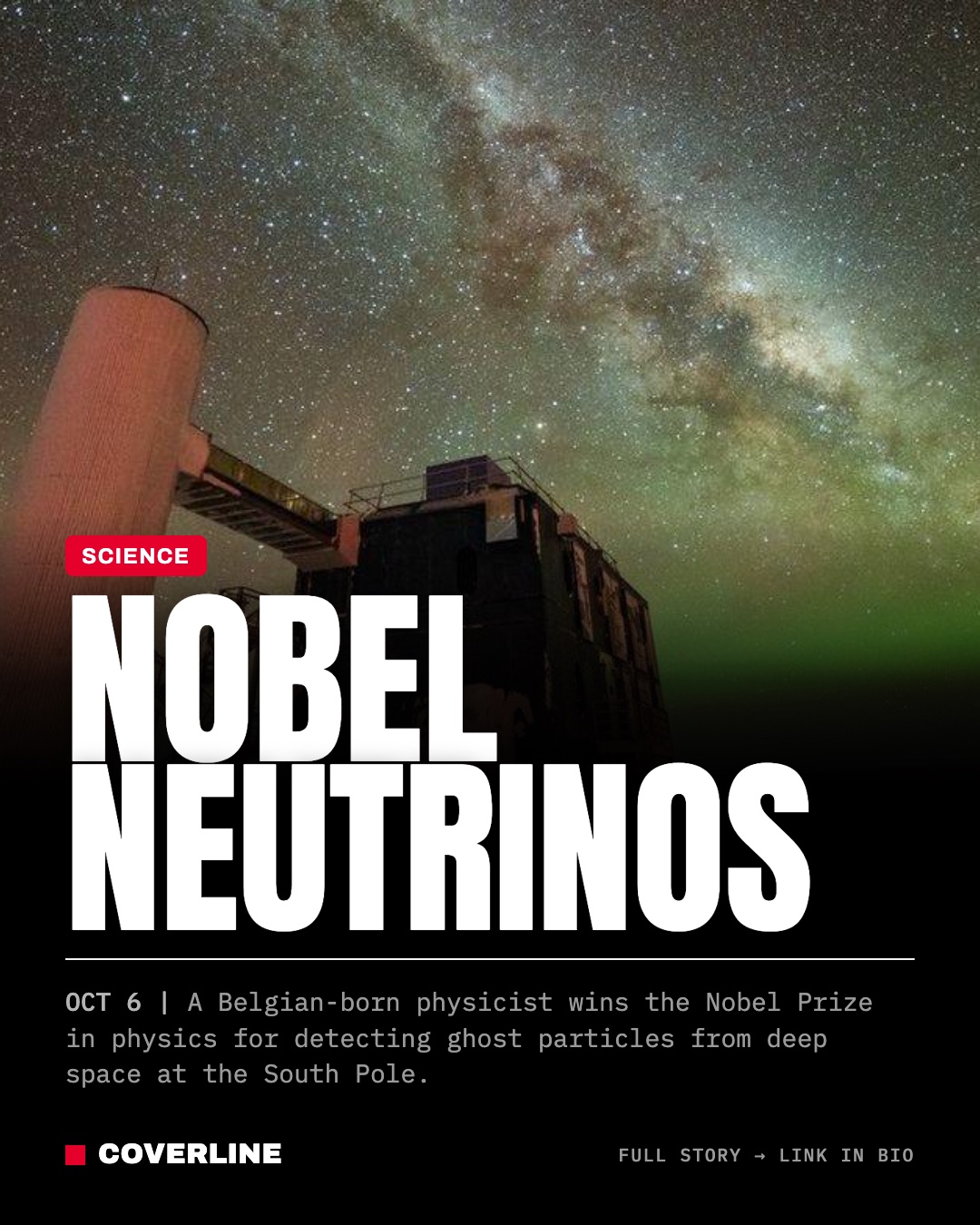
Francis Halzen won the Nobel Prize in physics Tuesday for discovering high-energy neutrinos from deep space, the Royal Swedish Academy of Sciences said.
He's 82, Belgian-born, and teaches at the University of Wisconsin-Madison, NPR reported. The physicist has since become a U.S. citizen, according to BBC News. The prize carries 12 million Swedish kronor, about $1.2 million, NPR said.
Halzen's work centers on IceCube, a neutrino detector frozen into the ice at the South Pole. The observatory holds 5,160 light sensors spread through a cubic kilometer of Antarctic ice, Nature reported. Crews finished building it in 2010 at a cost of $271 million, funded mainly by the U.S. National Science Foundation, according to Nature. Roughly 450 researchers work on the project now.
Neutrinos are nearly impossible to see. Billions of them pass through a human hand every second, Nature reported, though the high-energy kind Halzen studies are far rarer. They pass through matter. Magnetic fields don't bend their path either, BBC News reported, so it points straight back to where they came from: exploding stars, distant galaxies, the violent regions around black holes.
Halzen first proposed building a detector at the South Pole in 1988, BBC News reported. Few thought it would work. "I have to emphasise how lucky I was," he told reporters, according to BBC News. "Very few thought it would work, including myself."
Mark Pearce chairs the Nobel Committee for Physics. He credited Halzen's persistence. "His tenacity and scientific vision has paved the way for a new kind of astronomy," Pearce told NPR.
Within two years of switching on, IceCube had already detected neutrinos from beyond the Milky Way, Nature reported. That discovery helped open a field researchers now call multimessenger astronomy, which pairs neutrino readings with light and gravitational-wave data, Scientific American reported.
IceCube's funding faces a cut. The Trump administration's 2027 budget proposal calls for halving the observatory's support, Scientific American reported.
More Nobel announcements are coming. The chemistry prize comes Wednesday, literature Thursday, and the peace prize Friday, NPR reported, with the economics prize set for Monday, Oct. 12.
"After one and a half decades of development, and another decade of construction, there was no guarantee we would ever see anything," Halzen told APS News last year, according to Nature. "Many people thought we wouldn't, but we did."