Chemistry Nobel
Two chemists win the Nobel Prize in Chemistry for explaining why life builds only one-handed molecules.
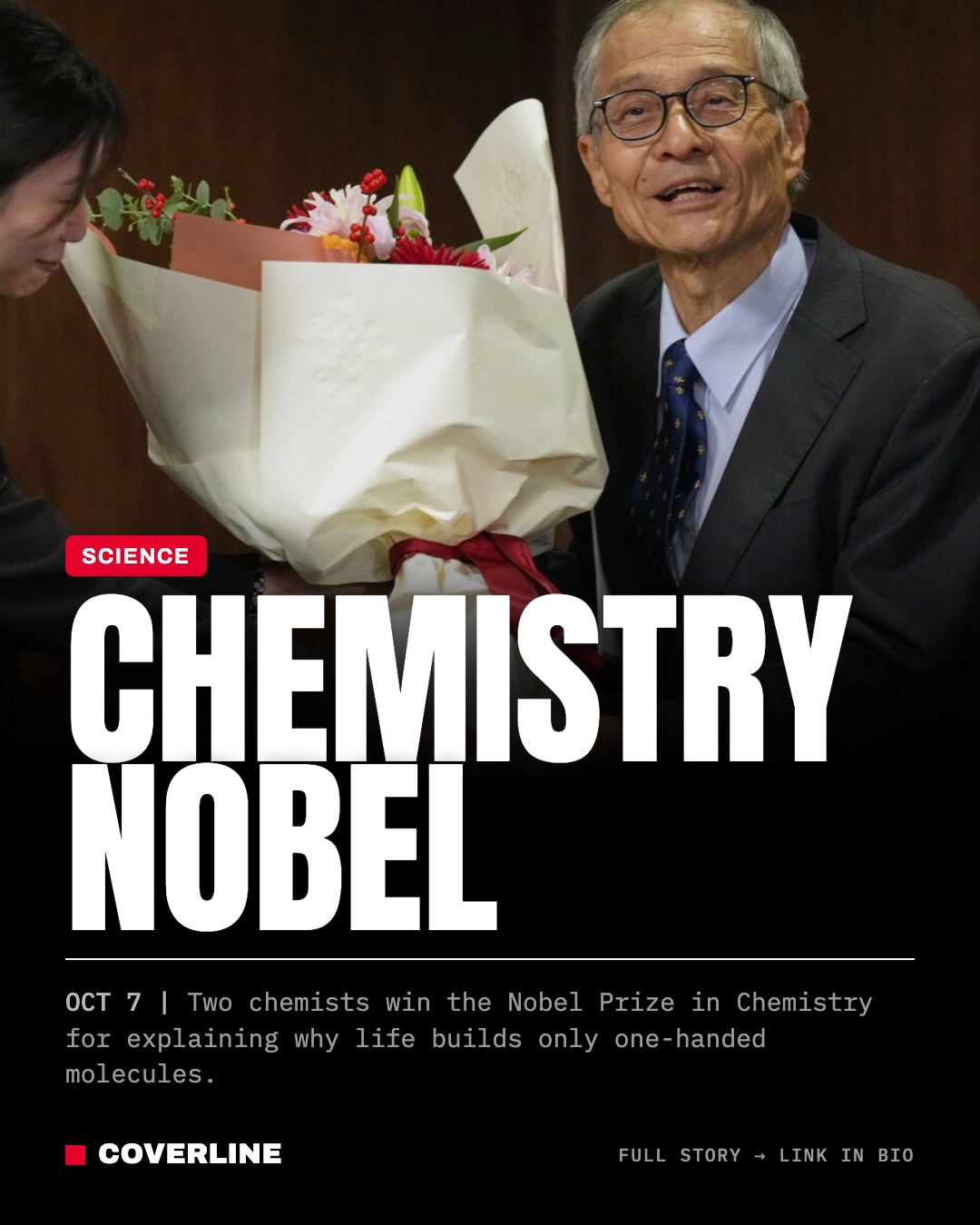
Wednesday, the Royal Swedish Academy of Sciences awarded the Nobel Prize in Chemistry to Henri Kagan of France and Kenso Soai of Japan.
The two chemists solved a puzzle that had stood for more than a century, BBC News reported. Living things build molecules in only one of two possible mirror-image forms. Amino acids, the building blocks of proteins, come in left and right versions. Like a pair of hands. Nature almost always picks one. Left alone, a lab reaction produces an even split of both.
In medicine, that split matters most. BBC News cited the drug thalidomide, given to pregnant women in the 1950s for morning sickness, as a case where one mirror-image form eased symptoms and the other caused severe birth defects. Kagan found a way in 1986 to tilt a reaction toward one mirror image over the other. Soai went further. He published a 1995 paper in the journal Nature describing a reaction capable of producing only the desired form, then controlled it fully by 2003, BBC News reported.
NPR reported that the work, built on a process called autocatalysis, now underlies the design of countless drugs. Rigoberto Hernandez, president of the American Chemical Society, told NPR that "the medicines we have today would not be possible without this chemistry." Soai learned of the award while shopping at a neighborhood supermarket, NPR said. He called it "one of the most exciting days" of his life.
French President Emmanuel Macron congratulated Kagan, calling the prize "an immense source of pride for the country" and "a recognition befitting a lifetime of research," according to NPR. The Nobel committee wrote in a statement that no one but life itself had managed the feat before.
Scientific American reported that Soai, 76, of the Tokyo University of Science, said plenty remains unknown about how chirality first emerged in life. Kagan, 95, is still affiliated with Université Paris-Sud in Orsay. Peter Somfai, a member of the Nobel Committee for Chemistry, told Scientific American the pair's discoveries "have reshaped our understanding of molecular chirality, how it is created, amplified and transmitted."
At a Wednesday news conference, Soai praised the "many, many excellent researchers" who worked in the field alongside him, BBC News reported.