Election Deadlock
Israel's election leaves no clear winner, with Netanyahu's bloc ahead of Eisenkot's but both short of a parliamentary majority.
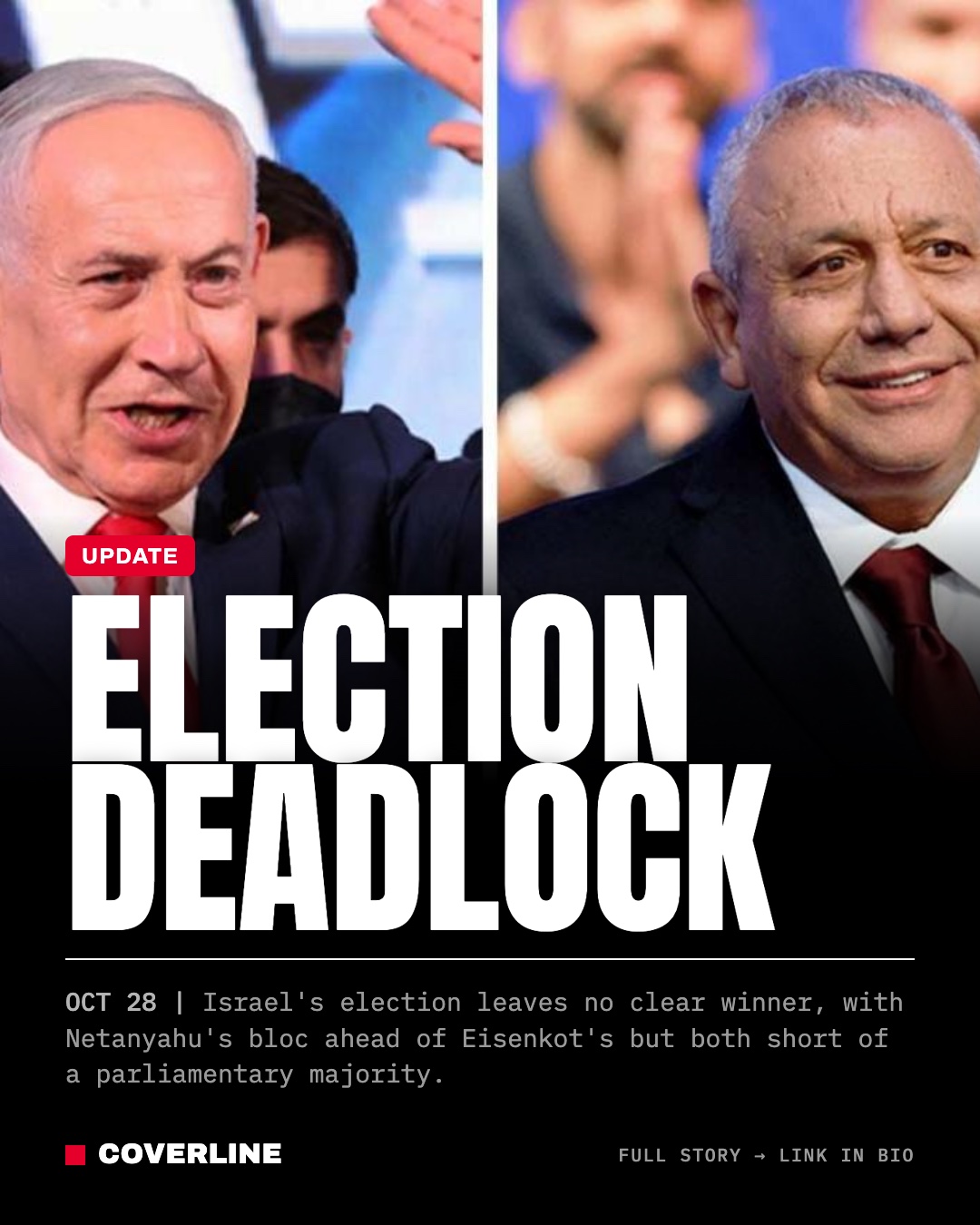
Israel's election produced no winner. Benjamin Netanyahu's bloc led rival Gadi Eisenkot's, but neither commanded a majority in the 120-seat Knesset.
With 93% of ballots counted, Likud and its far-right and ultra-Orthodox allies were tracking toward 53 seats, BBC News reported. Eisenkot's Yashar party and three allied opposition parties were set for 48. Arab-led parties were on course for a record 19 seats, BBC News reported.
Neither side can reach the 61 seats needed to govern without those Arab parties, but almost every Jewish party, including Netanyahu's own bloc and most of Eisenkot's allies, has ruled out working with them. Eisenkot, a former military chief whose son was killed in the Gaza war, called Netanyahu unfit to lead, the New York Times reported. Addressing supporters, Netanyahu invoked his relationship with President Trump and his record on Iran, the Times reported.
Israel's Central Elections Committee confirmed it received a complaint from Likud alleging Arab parties had compromised the vote, and pledged to review the claims, the Guardian reported. The party offered no evidence. Yair Golan, leader of the Democrats party in Eisenkot's bloc, planned to meet Eisenkot and Yair Lapid to begin coalition talks, the Guardian also reported.
Counting continued Thursday on hundreds of thousands of absentee ballots cast by soldiers, diplomats and hospital patients, DW reported. Officials do not expect those ballots, numbering between 430,000 and 480,000, to change the outcome much. A full count was expected by Thursday afternoon, DW reported, with finalized official results due November 4.
Herzog will then consult every party and ask whichever leader he judges likeliest to succeed to try to form a government, BBC News reported. That could take weeks. No guarantees either way. If it fails, Israel would vote again.
Turnout hit 77.7%, the highest in more than two decades. Herzog called it "a badge of honour for Israeli society," BBC News reported. He added that he wanted every party "to come with an open mind."